Overview
The Executive Challenge
The future of work is undergoing one of the most significant structural shifts since the emergence of the digital economy. As Agentic AI evolves from a productivity tool into an active participant in enterprise decision-making, organizations are rethinking how work is designed, how decisions are made, and where human expertise creates the greatest value. While this transformation presents unprecedented opportunities for innovation and efficiency, it also exposes a critical leadership challenge: how do organizations ensure that human capability evolves at the same pace as intelligent technology?
Many organizations continue to respond to this challenge using workforce development models designed for a different era. Training programmes remain focused on teaching tools rather than strengthening judgment. Career guidance often concentrates on helping individuals secure their next role instead of preparing them for continuous reinvention. Executive workshops frequently transfer knowledge but rarely redesign leadership behaviours, decision-making, or organizational capability. As technology advances, the gap between digital transformation and human capability continues to widen.
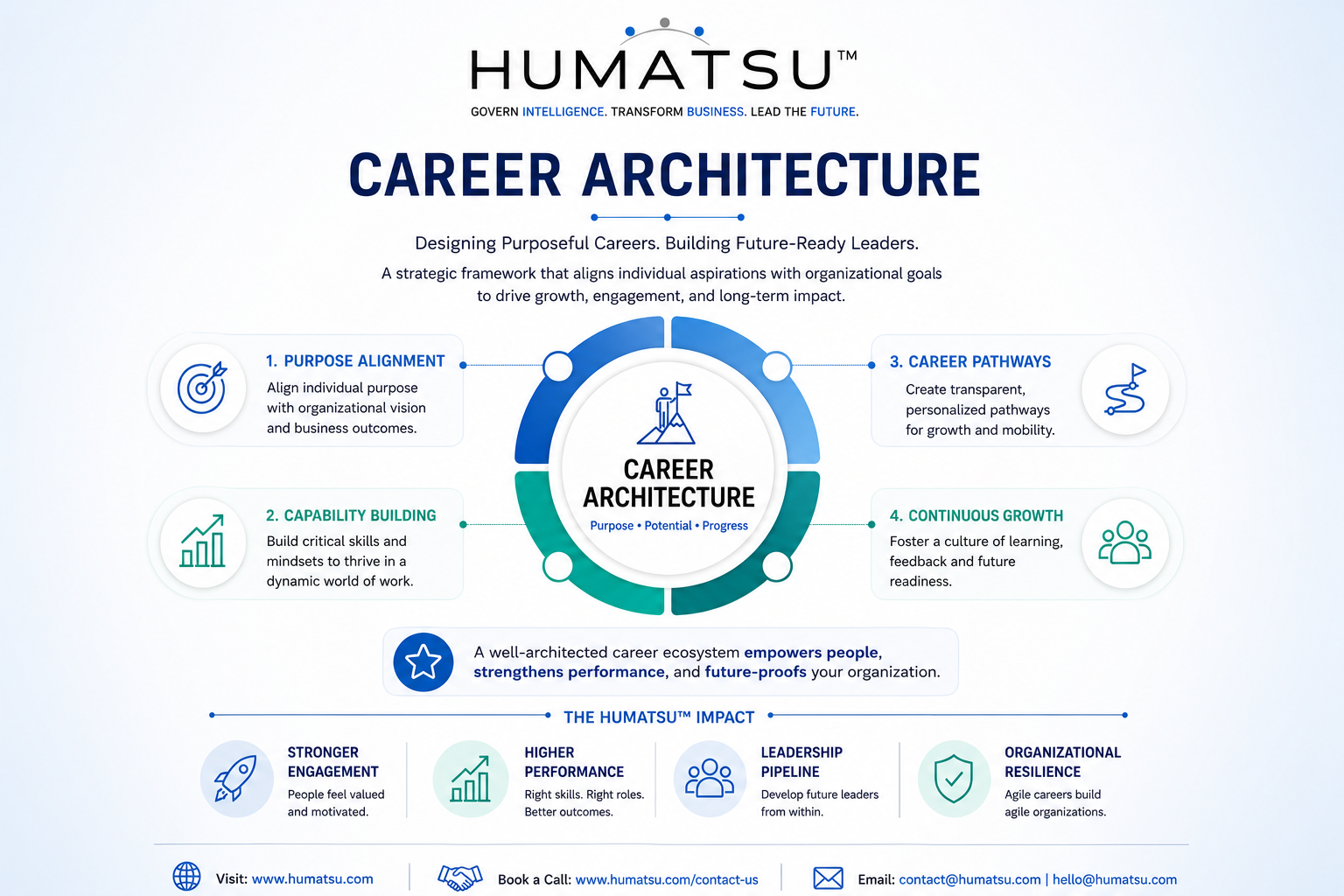
At HUMATSU, we believe the challenge is not simply one of reskilling—it is one of architectural design. Sustainable transformation requires organizations to intentionally redesign how people learn, lead, collaborate, and create value alongside intelligent systems. We describe this philosophy as Career Architecture & Capability Building—a strategic approach that enables organizations and professionals to continuously evolve, strengthen human capability, and lead confidently in the age of intelligent autonomy.
The Executive Blind Spot
Most organizations believe they have a skills challenge. They invest heavily in certifications, learning platforms, AI tools, and technical training, assuming that greater knowledge will naturally produce better business outcomes. While these investments remain important, they often address only the visible symptoms of transformation rather than its underlying causes.
The more fundamental issue is that organizations continue to develop people for jobs that are rapidly changing or, in some cases, disappearing altogether. Technical competencies evolve quickly, software platforms are continuously updated, and many operational activities are increasingly delegated to intelligent systems. The competitive advantage of the future will therefore depend less on what professionals know today and more on their ability to adapt, exercise judgment, collaborate with AI, and continuously build new capabilities.
Transformation cannot be achieved simply by adding more training to an existing operating model. Organizations must rethink how professional capability is developed, sustained, and renewed throughout the employee lifecycle.
Why Traditional Career Development Is Reaching Its Limits
For decades, career development followed a relatively predictable path. Professionals acquired technical expertise, accumulated experience through increasingly complex responsibilities, and progressed into leadership positions. This model assumed that knowledge would remain valuable for years and that organizational structures would evolve gradually.
That assumption no longer holds true. The pace of technological innovation has shortened the lifespan of many technical skills, while intelligent automation is redefining the nature of work itself. Entry-level responsibilities that once developed analytical thinking and business judgment are increasingly automated. Teams are expected to collaborate with intelligent systems, make faster decisions, and solve more complex business problems than ever before.
This creates an important leadership challenge. If organizations focus exclusively on teaching employees how to use AI, they may unintentionally neglect the uniquely human capabilities that enable people to govern, validate, and improve intelligent systems. The objective of professional development should therefore extend beyond technical proficiency to include critical thinking, strategic judgment, ethical reasoning, systems thinking, collaboration, and leadership.
The HUMATSU Perspective
At HUMATSU, we believe careers should no longer be viewed as a sequence of roles or promotions. They should be viewed as evolving systems of capability.
Career Architecture & Capability Building is built on the principle that long-term professional success is determined not by expertise in a particular technology but by the ability to continuously create value regardless of how technology evolves. Rather than asking, "What job should I prepare for next?" professionals should be asking, "What capabilities will remain valuable throughout my career?"
This perspective fundamentally changes the way organizations approach workforce development. Instead of designing learning programs around software platforms or individual job descriptions, leaders should focus on strengthening the enduring capabilities that support innovation, sound decision-making, organizational resilience, and effective leadership. Technology will continue to evolve, but the human capacity to interpret complexity, resolve ambiguity, build trust, and exercise judgment will remain central to sustainable business performance.
Career Architecture & Capability Building
💡 Example Artifact: Explore a sample 🔗HUMATSU Diagnosis Report to see how capability architecture is mapped and evaluated in practice.
Career Architecture begins by helping professionals identify what HUMATSU describes as their Value Anchor—the combination of expertise, experience, leadership behaviors, and uniquely human strengths that continue to create value regardless of technological disruption. While technical skills may evolve every few years, a professional's ability to solve complex business problems, influence stakeholders, lead transformation, or build strategic relationships often becomes increasingly valuable over time.
Capability Building extends this philosophy from the individual to the enterprise. Organizations must intentionally design environments where learning becomes continuous, collaboration becomes multidisciplinary, and AI enhances rather than replaces human capability. This requires leaders to move beyond traditional training programs and create opportunities for practical experimentation, reflective learning, executive mentoring, and cross-functional problem solving.
The objective is not to prepare people for the next technology implementation. It is to prepare them for continuous professional evolution.
Reimagining Workshops as Transformation Labs
The role of executive workshops must also evolve.
Traditional workshops often focus on transferring knowledge through presentations and structured learning activities. While informative, they rarely create the behavioral or organizational changes required for long-term transformation.
At HUMATSU, workshops are designed as transformation labs—interactive environments where leaders and teams work through real organizational challenges, test new ways of thinking, and develop practical strategies for implementation. Every engagement combines strategic advisory, human-centered change, enterprise transformation principles, AI-enabled ways of working, and collaborative problem-solving.
Participants leave with more than information. They leave with a clearer understanding of how to redesign work, strengthen leadership capability, and create sustainable organizational change.
A New Role for Career Consulting
Career consulting must evolve alongside the workplace.
Rather than focusing exclusively on resumes, interviews, or short-term career transitions, future-ready career advisory should help professionals understand where industries are heading, how business models are changing, and which capabilities will continue to create value over the next decade.
HUMATSU's Career Architecture & Capability Building advisory is designed to help leaders, experienced professionals, and emerging talent navigate this complexity with confidence. We work with individuals to strengthen executive presence, build strategic capabilities, develop AI literacy, prepare for leadership responsibilities, and design careers that remain resilient in an environment of continuous technological change.
Our objective is not simply to help clients find their next opportunity. It is to help them become the architects of their own professional future.
The HUMATSU Point of View
Every generation experiences technological disruption. What distinguishes today's transformation is not simply the pace of innovation but the need to redesign the relationship between human capability and intelligent technology.
Organizations that continue to view learning as an isolated activity and career development as a sequence of promotions will struggle to keep pace with this change. Those that intentionally invest in capability, leadership, and continuous professional evolution will build workforces that are not only adaptable but capable of shaping the future rather than merely responding to it.
At HUMATSU, we believe the future of work belongs to organizations that architect human capability with the same discipline they apply to technology transformation. Sustainable success will not be determined by who deploys AI the fastest but by who develops the leadership, judgment, and organizational capability to use it wisely.
Because in the age of intelligent autonomy, careers are no longer simply managed.
They are intentionally architected.