Overview
The Strategic Governance of Human Capability
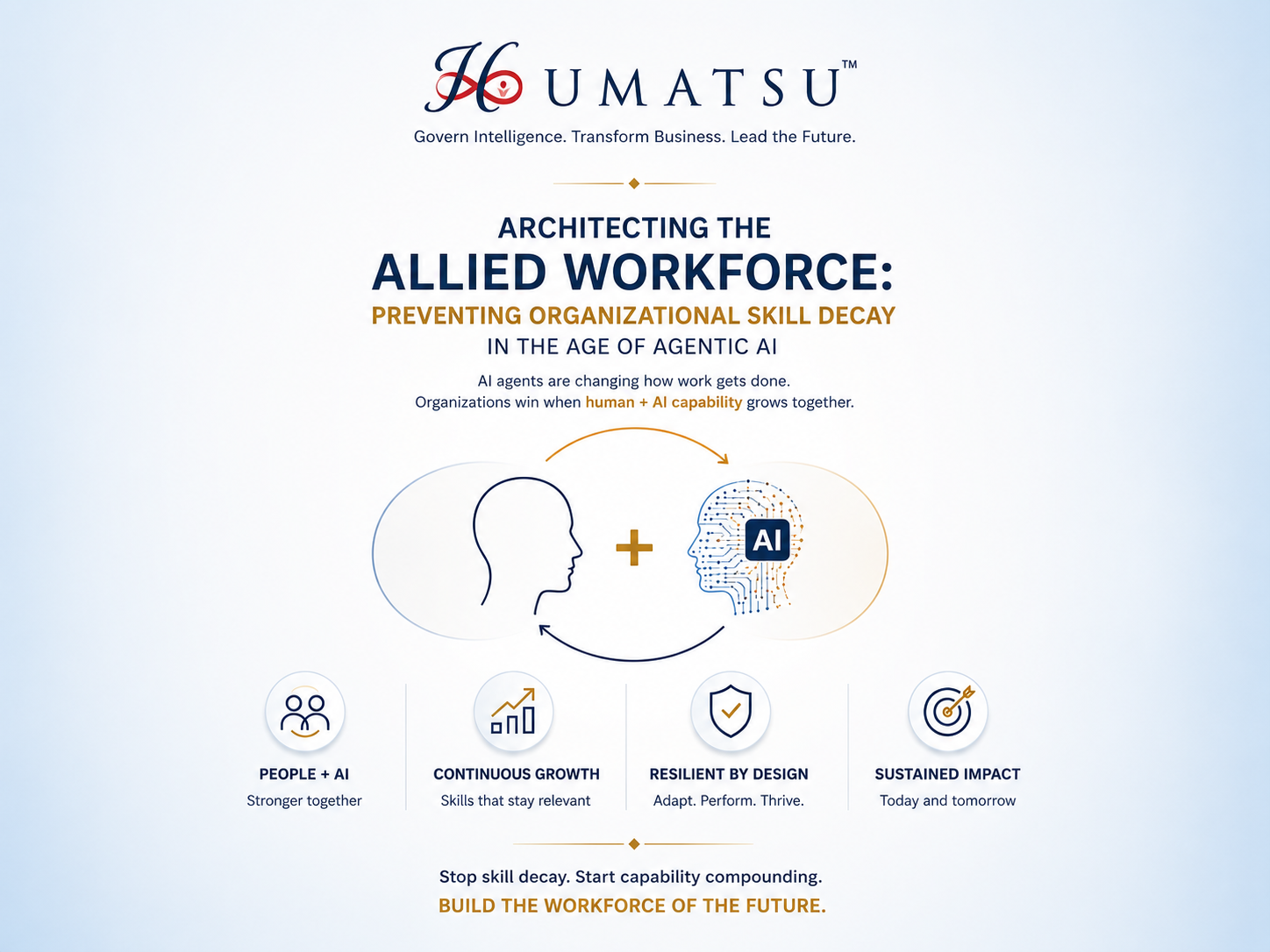
As enterprises accelerate the deployment of Agentic AI, a critical governance gap has emerged: the atrophy of foundational human tradecraft. Organizations are mistakenly treating this as a workforce training issue, when it is, in fact, a strategic enterprise risk. By automating entry-level and intermediate tasks, organizations are inadvertently eroding the very domain expertise—the "institutional intuition"—required to oversee AI agents and ensure business continuity when autonomous systems fail.
At HUMATSU™, we posit that the C-suite must evolve its mandate. Governance is not merely about managing the AI; it is about governing human capability in an era where technology is a core organizational actor. Just as we govern AI systems to prevent "agent sprawl," we must govern human capability to prevent "tradecraft atrophy."
1. From Task Execution to AI Orchestration
The primary objective of workforce transformation is to transition the enterprise from manual task execution to high-value AI Orchestration. This requires a fundamental redesign of work where employees are no longer "operators" but "architects of agency."
Board-Level Mandate: * Define Autonomy Boundaries: Distinguish between delegated tasks (high volume, low risk) and strategic tradecraft (low volume, high risk) that must remain human-centric.
Role Reclassification: Transition roles from "Task Executor" to "Agent Orchestrator" and "Adversarial Validator," formally accounting for these new responsibilities in enterprise job architectures.
2. The HUMATSU™ Human Capability Governance Framework
To effectively govern human capability, organizations must adopt a structured architecture that balances AI speed with human resilience. This framework ensures that AI adoption does not hollow out the organization’s long-term leadership pipeline.
| Governance Pillar | Strategic Objective | Human Capability Focus |
|---|---|---|
| Orchestration | Defining agent parameters | Shift from execution to oversight |
| Validation | Stress-testing agent outputs | Adversarial Robustness Assessment |
| Resilience | Maintaining business continuity | Deliberate Practice & Manual Overrides |
| Mentorship | Preserving institutional knowledge | AI-Augmented Tradecraft Transfer |
3. Mitigating the Risk of Skill Degradation
The greatest danger to the modern enterprise is "Automation Bias"—the tendency for employees to trust autonomous systems implicitly, losing their ability to identify "drift", hallucinations, or logical failures.
Executive Imperative:
Institute Deliberate Practice: Design operational workflows that include simulated "manual failure" scenarios. This forces employees to solve problems manually, ensuring they retain the diagnostic skills to intervene when AI drifts.
Mandate Adversarial Assessment: Train orchestrators not just on how to build but also on how to break the agent's logic to test reliability under edge-case conditions.
4. The HUMATSU™ Advisory Position: Governance Before Automation
We reject the notion that AI governance is purely a technical or compliance-based exercise. It is a governance of power, accountability, and capability. To achieve Transformation Sovereignty, boards must treat workforce capability as a non-negotiable asset, overseeing it with the same rigor applied to financial governance, cyber resilience, and enterprise risk management.
Build capability that scales with change. Organizations ready to stress-test their human-AI resilience can begin with a HUMATSU™ Capability Audit. HUMATSU™ enables organizations to bridge the gap between technological deployment and human-centered reality, ensuring that your people remain the primary architects of your business future.